Emirates Conformity Assessment Scheme (ECAS-Ex): A Complete Guide for Businesses in the UAE
Share Post :
For manufacturers, importers, and traders, it’s highly overwhelming to navigate regulatory compliance in the UAE. The most significant of these requirements is ECAS certification in the UAE, which is a necessary approval that guarantees that products comply with the national safety and quality standards. It is critical for the companies that are planning to enter or are already in the UAE market to fully understand ECAS.
In an obvious and practical manner, this blog dissects the Emirates Conformity Assessment Scheme while highlighting how expert consultants like Leela International can simplify the entire journey.
What Is the Emirates Conformity Assessment Scheme (ECAS-Ex)?
The Emirates conformity assessment scheme is a regulatory mechanism that the UAE government has put in place to guarantee the compliance of products with established technical standards before they are sold in the country. The Ministry of Industry and Advanced Technology (MOIAT) manages ECAS, which not only safeguards consumers but also fosters fair trading and brings the UAE in line with international standards of operation.
The Emirates Conformity Assessment Scheme mandates that certain regulated products, such as electrical goods, cosmetics, food-contact materials, and construction products, undergo an evaluation and approval process before they get a chance of entering the UAE market. The lack of the required certification may result in the products being stuck at customs or taken off the store shelves, which would cause delays and, probably, financial losses as well.
Why ECAS Certification Matters for Businesses
Acquiring ECAS certification in the UAE is not just a legal formality, but it is a process that signifies the product’s safety, gives consumer trust, and, thus, allows the company easy entrance to the market. The companies that comply early reduce the time of waiting, do not pay fines, and have a better position in the market.
On the other hand, in terms of business, ECAS certification in the UAE draws the attention of the distributors and retailers to the fact that your products are legally compliant with the national standards. Moreover, it serves as a safeguard against the possibility of delayed shipments and costly reprocessing for importers.
Main Objectives of ECAS
1. Market Regulation: It helps to prevent the entry of substandard goods into the UAE market.
2. Consumer Protection: ECAS ensures that products meet high-quality standards and are safe for use.
3. Eco-friendly Sustainability: Certain ECAS standards promote energy efficiency and eco-friendly practices.
Understanding the ECAS Registration Process
The ECAS registration process in Dubai is a structured, document-driven procedure designed to verify compliance before products reach consumers. First-time applicants may find the technical requirements complex due to their digitalization.
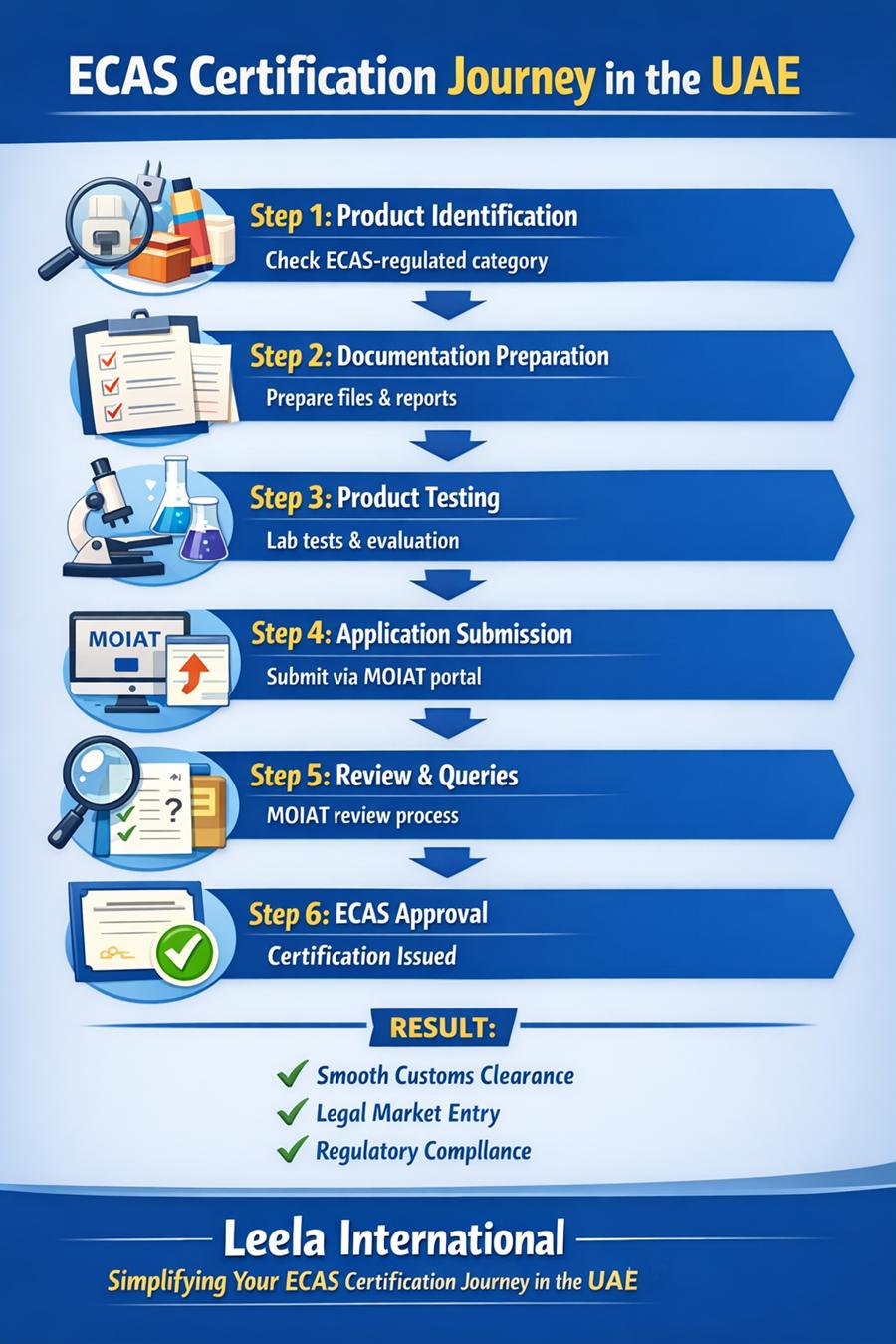
Typically, the ECAS registration process in Dubai involves:
• Identifying whether your product falls under regulated categories
• Preparing technical files and test reports
• Submitting an application through the MOIAT portal
Coordinating product evaluation and review
A well-managed ECAS registration process in Dubai ensures faster approvals and fewer queries from authorities.
Role of MOIAT in ECAS Approval
MOIAT ECAS approval is at the heart of the structure, being the formal verification that a product conforms to the standards of the UAE. MOIAT ECAS approval, however, is a long and energetic process. For UAE manufacturers, this process carries the heaviest burden.
MOIAT ECAS approval is the most important step, as it is the ultimate proof that the product is satisfactory to the customs authorities and is admitted to the country without further investigations. MOIAT approval can sometimes take up to 2–3 months; hence, having an expert consultant such as Leela International along during this time is really invaluable.
ECAS Compliance for Imported Products
ECAS compliance for imported products is especially important for global manufacturers and traders. Imported goods must meet the same standards as locally manufactured items, regardless of origin.
Achieving ECAS compliance for imported products typically requires internationally accredited test reports, accurate labeling, and conformity declarations. Failure to comply can disrupt supply chains and damage brand credibility in the UAE market.
Understanding the ECAS registration process in Dubai provides access to a broader range of GCC and Middle East markets, given Dubai’s role as a regional trade hub.
Documentation checklist to obtain ECAS certificate
1. Official files comprising product specifications.
2. Test findings from labs recognized by ISO 17025.
3. User guides translated into Arabic.
4. Labelling details such as model designation, company name, electrical ratings, etc.
Application forms duly signed by an authorized representative
Common Challenges Businesses Face
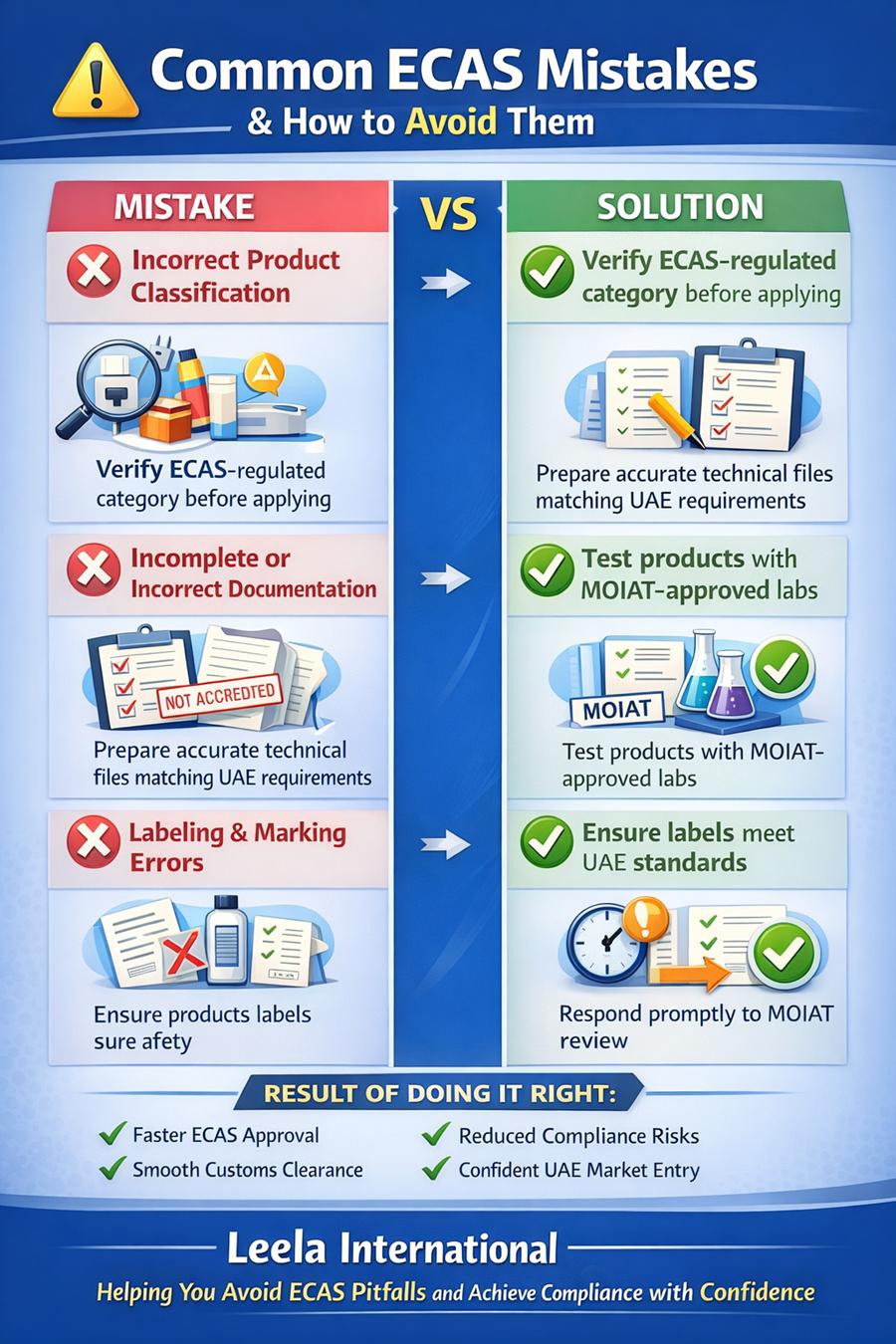
Despite clear guidelines, companies often struggle with documentation gaps, incorrect product classification, or misinterpreted standards under the Emirates conformity assessment scheme. These challenges can delay approvals and increase costs if not addressed early.
Additionally, incomplete submissions can slow down MOIAT ECAS approval, especially when technical files do not fully align with product specifications.
Conclusion
Achieving the ECAS certification in the UAE is a strategic step toward sustainable business growth. Regulations evolve, and compliance gets stricter; expert guidance is no longer an option—it’s crucial.
Leela International helps businesses to get ECAS compliance for the imported products efficiently by managing technical reviews, coordinating testing, and liaising directly with authorities. We provide end-to-end support from documentation review to final approval, ensuring accuracy, speed, and complete regulatory alignment so your products reach the UAE market without obstacles.
Leela International: Simplifying the Emirates Conformity Assessment Scheme with Confidence and Compliance.
FAQ’S
Is ECAS mandatory for all products in the UAE?
No, ECAS applies only to regulated product categories identified by MOIAT.
How long does the ECAS process take?
Timelines vary, but a properly managed ECAS registration process in Dubai can significantly reduce delays.
Who issues ECAS certificates?
Certificates are granted after successful MOIAT ECAS approval.
Can foreign manufacturers apply for ECAS?
Yes, especially when ensuring ECAS compliance for imported products.
What happens if a product is sold without ECAS?
Products may be rejected, fined, or removed from the market.