A Special Purpose Vehicle (SPV) is a separate legal entity that allows investors to own shares, property, or other assets. Eligibility, service-provider obligations, and fees differ between the two UAE frameworks offered by ADGM and DIFC.
A well-designed SPV can provide an ideal structure for investment holding, asset and liability separation, and control of investment ownership. In this blog, Leela International guides you to choose the right UAE holding structure for your assets, investors, and long-term plans.
What Is an SPV and Why Does the Jurisdiction Matter?
An SPV is a company that is not an active enterprise but is instead established to hold assets and liabilities separate from an owner’s broader business operations. It can be used for investment holding, restructuring, financing, or asset ring-fencing. It is not a tax shelter or an operating licence.
An ADGM SPV is incorporated in ADGM under its Companies Regulations. A DIFC Prescribed Company (PC) is the equivalent vehicle in DIFC. Both are used for holding and structuring, but they have different rules and filing requirements. The DIFC SPV vs ADGM SPV comparison requires investors to differentiate between the legal structure and the commercial intent.
ADGM SPV vs DIFC SPV: The Key Differences
1. Eligibility and Jurisdictional Connection
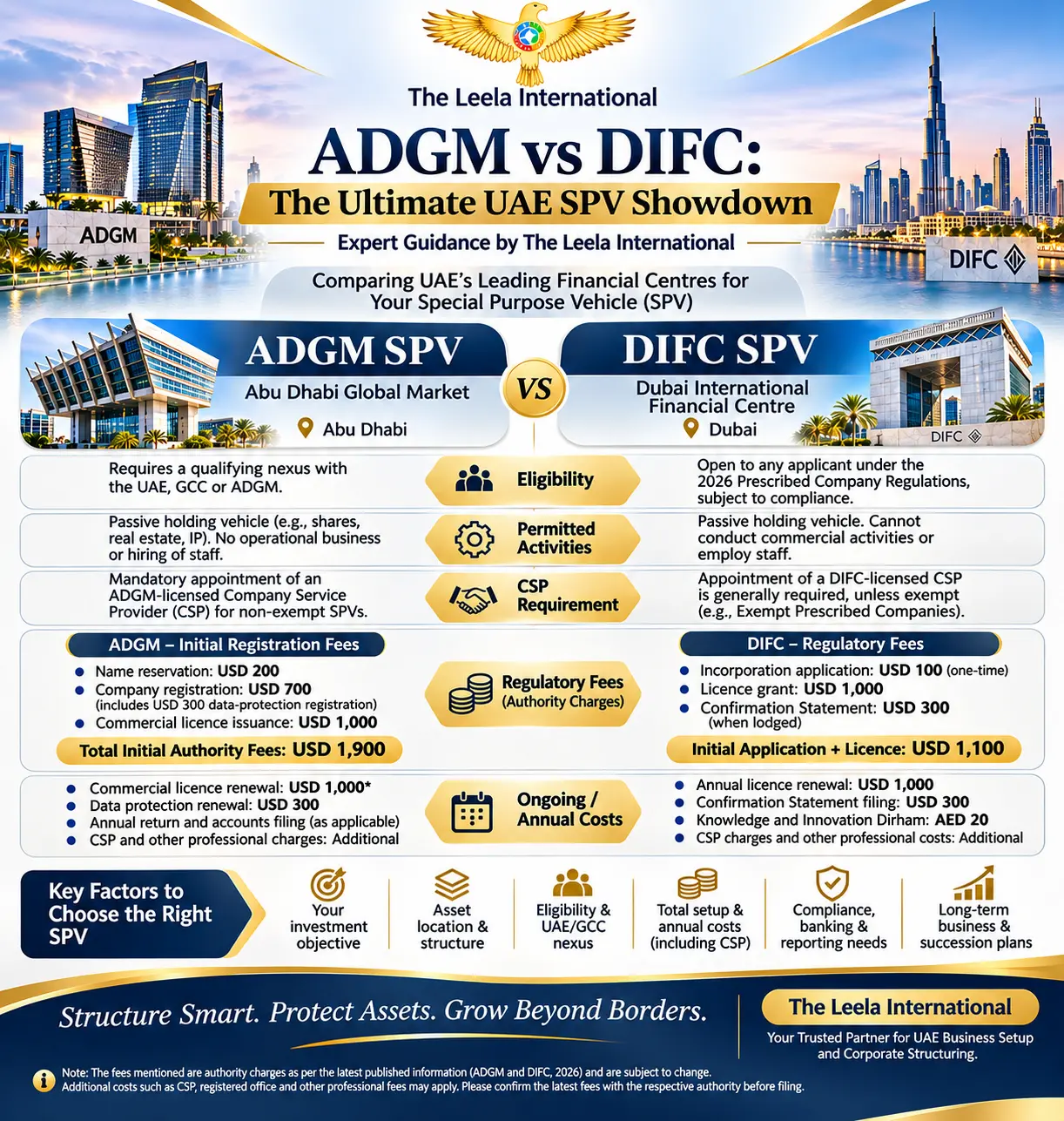
The first and most important part of a UAE SPV structure comparison is eligibility. For ADGM and DIFC, applicants must have an appropriate UAE, GCC, or ADGM connection. ADGM’s nexus guidance gives examples of qualifying connections: ownership or control by a UAE- or GCC-based individual, family, family office, or company; holding UAE/GCC assets; facilitating transactions connected with or providing economic benefit to the region; or certain securities-related purposes connected with ADGM. The registrar assesses applications, and appointing a local service provider alone does not establish nexus.
DIFC’s amended Prescribed Company Regulations under the 2026 regime state that the regime is now open to any applicant, subject to the regulations and applicable compliance requirements. This makes ADGM vs DIFC for holding company planning different from the earlier DIFC model.
2. Activities and Permitted Purpose
The two structures are intended to be passive. According to ADGM, there is no provision for operational business or staffing of SPVs. DIFC also states that prescribed companies are “passive holding companies” and are not permitted to hire employees. If your business requires staff members and/or customer interaction, consider a separate operating company with the necessary licence. This distinction belongs in every UAE SPV structure comparison, not as an afterthought.
3. Corporate Service Provider Requirements
An ADGM-licensed Company Service Provider (CSP) is required to be appointed for a non-exempt ADGM SPV. The CSP can act as the registered office and handle filings. Exemptions may apply.
Under DIFC’s rules, a prescribed company is required to have a DIFC corporate service provider unless it falls under the category of exempt prescribed companies. The CSP supports administration and compliance with the Registrar. Discuss the annual retainer and scope of services for ADGM and DIFC holding companies.
4. Setup Fees and Ongoing Costs
ADGM’s published registration fees list USD 200 for name reservation, USD 700 for company registration (including USD 300 data-protection registration), and USD 1,000 for the commercial licence: USD 1,900 in total. Its published brochure separately lists ongoing annual fees, including licence renewal, data protection, and confirmation statement charges. Check current fees before filing.
DIFC’s 2026 Prescribed Company Regulations list USD 100 for the incorporation application, USD 1,000 for a licence grant or renewal, and USD 300 for lodging a Confirmation Statement. The application fee is one-time; licence and statement fees recur. CSP charges are additional.
Therefore, SPV setup in the UAE should be budgeted for the first year and renewals. A realistic SPV setup in the UAE estimate includes CSP, registered-office, and filing costs.
How to Choose ADGM vs DIFC for Holding Company
The best option depends on the facts, not simply the headline fee. Compare ADGM SPV vs DIFC SPV across these practical questions:
- • Location of assets: Where are the registered shares, property, or investments?
- • Nexus: Is there a UAE/GCC connection that can be documented by the proposed ADGM structure?
- • Ownership: Who will be the owner and/or operator(s) of the vehicle?
- • Purpose: Will it remain passive and within permitted activities?
- • Administration: What CSP, registered-office, and filing support is needed?
- • Wider planning: Consider tax residence, banking, succession, and the laws where assets and owners are located.
This final SPV setup in the UAE decision should reflect the asset and ownership profile. A careful UAE SPV structure comparison should consider eligibility, asset location, and total cost. The right ADGM vs DIFC for holding company is the one that fits the purpose and compliance requirements of the structure.
There is no cookie-cutter answer to the ADGM SPV vs DIFC SPV question. Your assets and objectives should drive the proper structure. Leela International can assist with options for setup and coordination.
Before SPV setup in the UAE, consult on tax, asset transfers, beneficial ownership, and reporting. There is no automatic tax exemption or banking entitlement from incorporation.
Leela International can help explain your intention to hold, match requirements, arrange application paperwork from licensed CSPs, and prepare documentation for legal, tax, and banking advisors.
Leela International: Structure Smart. Protect Assets. Grow Beyond Borders.